

Revenue Architecture:
The Operating System for Recurring Revenue Growth
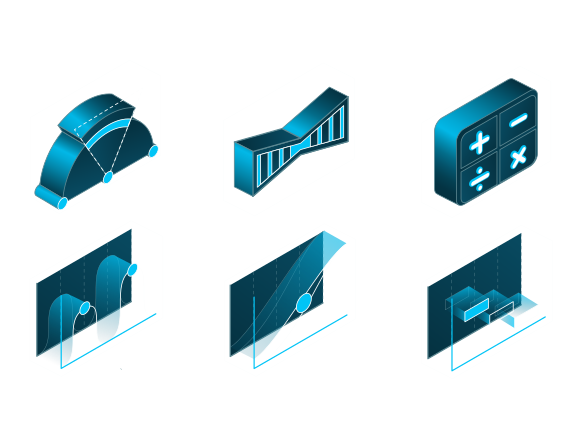
Revenue Architecture connects six scientific models into one system, so your revenue organization runs on shared logic instead of disconnected tactics.
A Complete Operating System for Recurring Revenue
Revenue Architecture from Winning by Design replaces that arrangement with one system. It defines how a recurring revenue business monetizes, measures, operates, and grows across six interconnected models. Every function works from the same logic, the same data, and the same language.
Revenue Architecture:
Six models. One system.
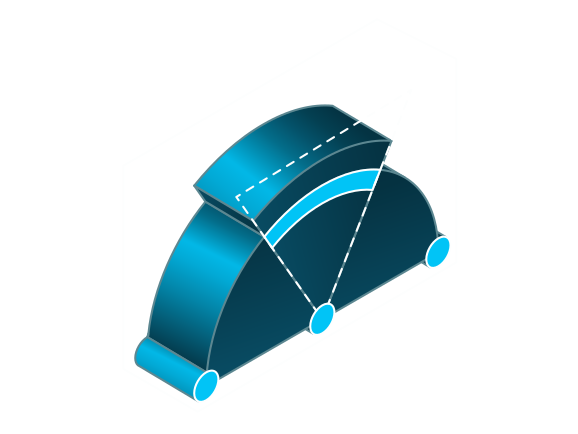
Revenue Model
How the business monetizes, across the three strategies of ownership, subscription, and consumption, each governed by different revenue principles.

Data Model
How the full customer lifecycle is measured, using the Bowtie to replace funnel thinking with one continuous view of acquisition, retention, and expansion.

Mathematical Model
How revenue behaves under different conditions, revealing where small improvements to incremental variables compound into exponential impact.
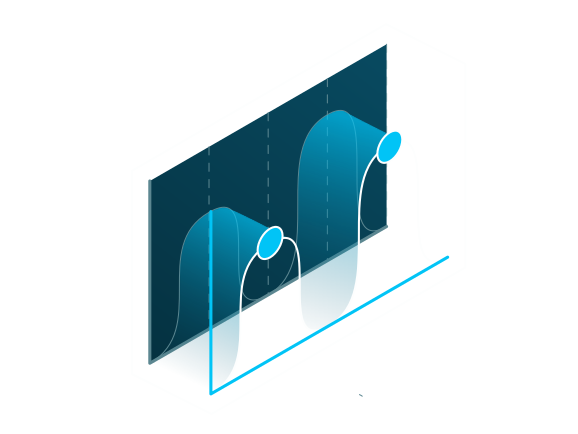
Operating Model
How teams execute, with one standardized data model, one shared language, and one methodology across every stage of the journey.

Growth Model
How the business scales along the growth S-curve, identifying revenue breakpoints and the phase shifts required to pass them.
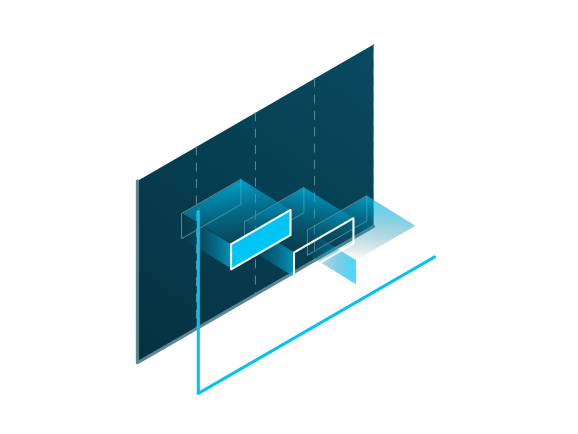
GTM Model
How marketing, sales, and customer success combine into deliberate go-to-market motions rather than parallel efforts.
Why We Created
Revenue Architecture
Recurring revenue changed the math of growth. Most organizations kept the old operating structure.
Marketing measures leads. Sales measures pipeline. Customer success measures renewals. Each function optimizes its own numbers, and each one improves in isolation. Total performance stays flat.
We created Revenue Architecture to give the entire revenue organization one scientific system. Not a methodology for one team. An operating system for the business.
The system is not the sum of its parts. It is the product of their interactions.
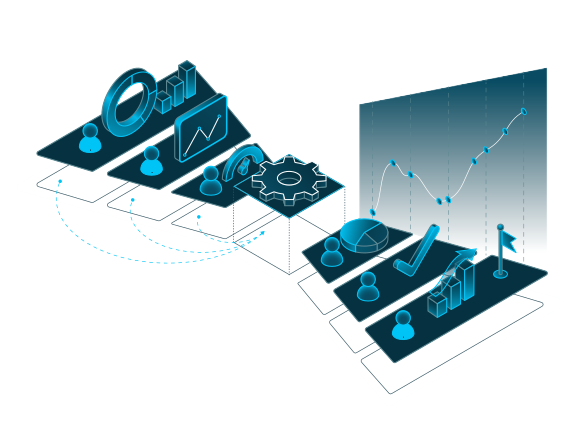
What Revenue Architecture Enables Across Your
Revenue Organization
Revenue Architecture gives leaders a common blueprint for how the business grows. Once the six models are aligned, decisions get faster and outcomes get more predictable.

One Language Across the Revenue Organization
Marketing, sales, customer success, and Rev Ops define the customer journey the same way, so handoffs and reporting stop requiring translation.

Growth Planning You Can Model
The Mathematical Model turns growth targets into a set of measurable variables, so planning becomes a calculation rather than a projection.

Diagnostics That Reach the Root Cause
When every function runs on the same data model, leaders can locate exactly where the system is constraining growth.

Clarity on Your Next Growth Stage
The Growth Model identifies the revenue breakpoints where an operating structure stops working, so teams prepare for the shift before it arrives.

A Deliberate Go-To-Market Motion
The GTM Model aligns customer-facing functions around a single motion matched to how your customers actually buy.

An Operating Cadence That Scales
Standardized data, language, and methodology mean new teams, regions, and products inherit a working system instead of rebuilding one.
Understand the System From the Source
Authored by Winning by Design founder Jacco van der Kooij, Revenue Architecture dives deeper into the frameworks and systems behind recurring revenue, expanding on the core models covered in this course with visual blueprints and practical insights every revenue leader should know.
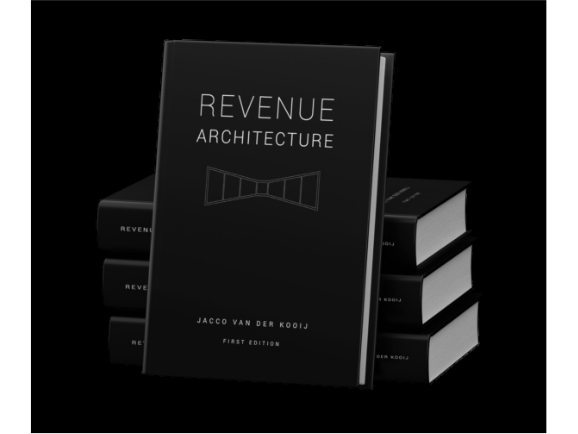
Revenue Architecture Resources
Learn the Science Behind the World’s Top Revenue Teams
Rather than teaching isolated skills or tactics, these courses focus on the underlying science — how acquisition, retention, and expansion interact as a system, how data and process shape outcomes, and how leaders can design growth that compounds instead of decays.

Executives trained to date
Revenue Architecture
Learn how to architect a full, modern revenue system, across six scientific models—from monetization and data models to growth and GTM alignment.
Essentials in Revenue Architecture
Learn the basics around the six critical revenue models and frameworks that unify marketing, sales, and customer success. Self-paced course options also exist.
Helping Revenue Teams Design Growth Around the Full Customer Journey










Design Your GTM Around Revenue Architecture
Every Winning by Design offering is built on Revenue Architecture. Our consulting engagements, workshops, certification courses, and research all run on the same six models, so whichever path you take, your team is working from one system rather than assembling advice from separate sources.
The result is a go-to-market engine your leaders can measure, forecast, and scale.
Revenue Architecture in Practice
Revenue Architecture becomes an operating model once it is embedded in your systems, metrics, and planning. These numbers reflect how organizations perform when the six models are aligned.

Decrease in length of sales cycle

Increase in wins

Increase in ARR year over year

Increase in outbound pipeline share
Helping Revenue Leaders Design Growth as a System


Frequently Asked Questions
What is Revenue Architecture?
Revenue Architecture is an operating system for recurring revenue businesses, created by Winning by Design. It defines how a company monetizes, measures, operates, and grows through six interconnected models: the Revenue Model, Data Model, Mathematical Model, Operating Model, Growth Model, and GTM Model. Rather than treating go-to-market as a set of separate functions, Revenue Architecture treats it as one designed system.
Who created Revenue Architecture?
Revenue Architecture was created by Winning by Design and documented by founder Jacco van der Kooij in the book Revenue Architecture. Winning by Design also created the Bowtie Model and SPICED, both of which sit inside the Revenue Architecture framework.
What are the six models in Revenue Architecture?
- Revenue Model — how the business monetizes, through ownership, subscription, or consumption.
- Data Model — how the customer lifecycle is measured, using the Bowtie.
- Mathematical Model — how revenue behaves, and which variables drive compounding impact.
- Operating Model — how teams execute against one shared language and methodology.
- Growth Model — how the business scales through growth stages and revenue breakpoints.
- GTM Model — how marketing, sales, and customer success combine into one motion.
How is Revenue Architecture different from the Bowtie Model or SPICED?
Revenue Architecture is the full system. The Bowtie and SPICED are components within it. The Bowtie is the Data Model, defining how the customer lifecycle is measured. SPICED is a methodology inside the Operating Model, defining how customer-facing teams run conversations. A company can adopt the Bowtie or SPICED on its own. Revenue Architecture connects them to the revenue, mathematical, growth, and GTM logic of the business.
Is Revenue Architecture a book, a course, or a framework?
Who should learn, understand, and use Revenue Architecture?
Revenue Architecture is designed for leaders accountable for how a recurring revenue business grows:
- CEOs and founders designing a growth engine for the next stage
- CROs and revenue leaders unifying go-to-market functions under one system
- Rev Ops leaders standardizing data models and reporting
- CFOs connecting revenue logic to financial planning
- Marketing, sales, and customer success leaders aligning their function to the wider system
How does Revenue Architecture relate to Rev Ops?
Rev Ops is a function. Revenue Architecture is the system that function operates. Revenue Architecture gives Rev Ops teams a defined data model, a standardized operating model, and a mathematical model for forecasting, which turns Rev Ops from a reporting function into the steward of the revenue system.
How do I implement Revenue Architecture in my organization?
Implementation usually starts with a diagnosis of the current system against the six models to find where the logic breaks. From there, organizations typically align on the Data Model first, standardize the Operating Model, then design the GTM Model around their growth stage. Winning by Design supports this through workshops, certification training, and consulting engagements (linked above).
Is Revenue Architecture only for SaaS companies?
No. It was developed within SaaS, but the models apply to any business where revenue recurs and long-term value comes from retention and expansion. Consumption-based, subscription, and hybrid models are all addressed directly in the Revenue Model.
Architect Your Revenue Organization
Revenue Architecture works when it becomes the shared system behind how your business plans, measures, and grows. Winning by Design helps you get there, through training your leaders or designing the system with your team.