GTM Process Design
ONE DOCUMENTED PROCESS EVERY TEAM ACTUALLY RUNS
Growth breaks down when every team runs its own version of the process. Deals close differently by rep. Handoffs depend on who remembers what. GTM Process Design maps your GTM motions to the Bowtie, our full-lifecycle revenue model, and turns them into one standardized process. Every stage gets clear milestones, ownership, and entry and exit criteria. Your team starts running one system.
Trusted by 1,000+ Companies Just Like Yours










When GTM runs on tribal knowledge, growth stays fragile
Fragmented process rarely breaks all at once. It breaks in stages. One team improvises around a gap, then another team improvises around theirs, then the customer feels the seams between them. Each crack is a signal that the process was never designed to hold together.

Every team runs its own version of the process
Sales runs deals one way in one region and another way in the next. Customer success hands off differently depending on who’s on the call. Nothing is wrong on paper, because nothing was written down.

Handoffs depend on memory, not milestones
No stage has a defined entry or exit. Deals move forward on judgment calls instead of shared criteria, so the same deal gets coached three different ways by three different managers.

Strategy stalls the moment it leaves the room
Leadership aligns on a new direction in a workshop, and it lives in a slide deck. Without a documented system to run against, the old habits come back within a quarter.
Replace siloed knowledge with one designed process
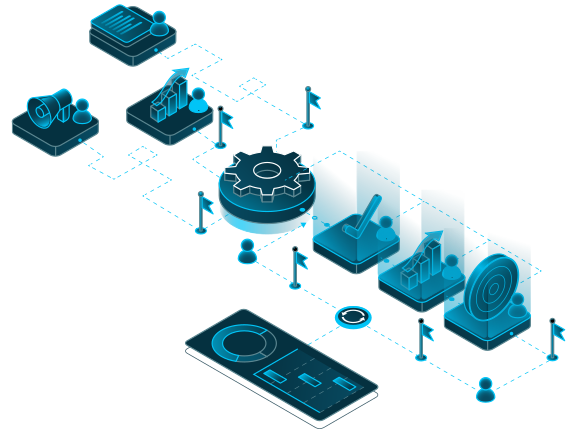
GTM Process Design turns your GTM motions into a single, standardized Bowtie process. We map your current process stage by stage and redesign it end to end, so instead of five versions of “how we sell” or “how we onboard,” there is one. Each stage gets a clear milestone, clear ownership, and clear criteria for what moves a deal or account forward.
When the process is designed instead of inherited, the economics shift. Handoffs stop leaking information. Coaching has a standard to coach against instead of individual habit. The process gets embedded into the systems and dashboards your team already uses, so it becomes how work actually gets done, not a document nobody opens again.
What You Get with
GTM Process Design
What’s included:
→ A designed Bowtie process
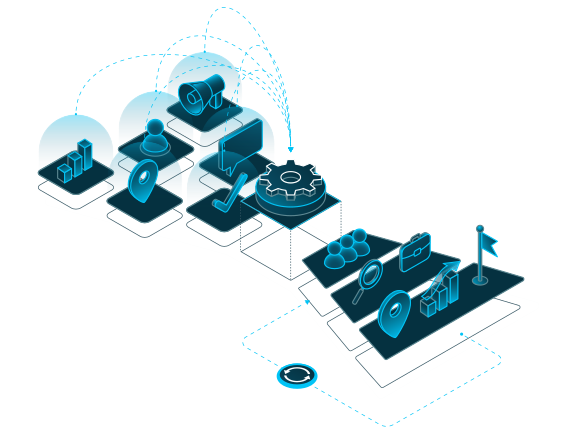
Your GTM motions, mapped to the full Bowtie or a single side of it, redesigned into one consistent process instead of several fragmented ones.
→ Defined stages and milestones
Every stage of the process named and sequenced, so every team knows what happens when.
→ Entry and exit criteria
Clear, objective criteria for moving a deal or account from one stage to the next, replacing individual judgment with a shared standard.
→ Ownership and accountability mapping
Defined responsibility at every stage, so handoffs stop depending on who happens to be involved.
→ A single source of truth
One documented version of how the business goes to market, removing the guesswork and debate that comes with five different versions.
→ Embedded systems and dashboards
The design built into the systems and dashboards your team already runs in, with guided support so the process gets adopted instead of shelved.
GTM Process Design
Redesign fragmented GTM motions into one standardized Bowtie process. Get defined stages, clear ownership, and a system embedded into daily execution, not a strategy deck that stalls after the workshop.

See What the Process Design Delivers
INSIDE THE DESIGN
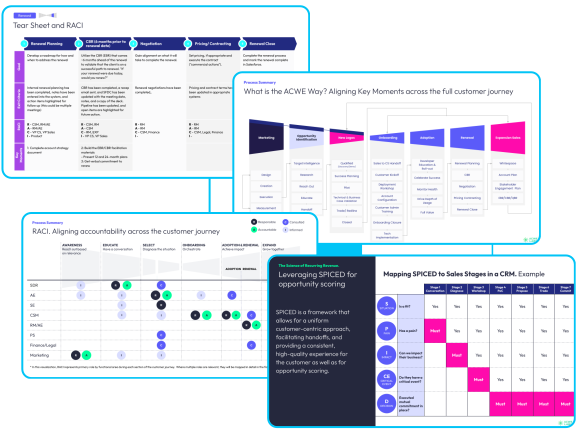
A GTM Process Design engagement produces working artifacts your team runs on, not a strategy deck. Each stage gets its own tear sheet, showing the goal, the exit criteria, and who owns it. A RACI grid maps accountability across the full Bowtie, so every function knows exactly where it’s responsible, consulted, or informed. Entry and exit criteria replace debate with a shared standard your whole team applies the same way.
The Science of Revenue, Proven in Practice
Our frameworks drive repeatable results across sales, success, and revenue operations—validated through customer performance data and real-world outcomes.

Decrease in length of sales cycle

Increase in wins
Increase in ARR year over year

Increase in outbound pipeline share
Your Path to a Documented, Unified GTM Process
Work with the Experts Designing
GTM Systems at Scale





Built for the Leaders Running the GTM
For CROs
You own the number, but the process behind it looks different depending on who’s running it. One rep closes one way, another closes a different way, and you can’t coach consistency into a system that was never designed.
- Get one documented process across sales, success, and Rev Ops
- Replace fragmented motions with shared stages and milestones
- Coach against a standard instead of individual habit
- Reduce forecast volatility caused by inconsistent execution
- Lead a team running one system, not five versions of one
For Rev Ops / GTM Ops
You’re asked to enforce a process that was never actually designed, so every fix is a patch on top of the last one.
- Get a documented Bowtie process to build systems and dashboards around
- Replace ad hoc rules with defined entry and exit criteria
- Reduce the fire drills caused by undocumented handoffs
- Embed the design into the tools your team already runs in
- Move from constant patching to owning a real system

For CEOs
You’re accountable for growth, but growth built on tribal knowledge doesn’t survive a new hire, a leadership change, or added pressure.
- See growth built on a documented system, not institutional memory
- Reduce the risk that execution quality depends on who’s in the room
- Give the board a process that scales instead of a story that doesn’t
- Move forward on a system the business can actually run
- Protect growth from turnover and change

For CFOs
You own the economics of growth, and inconsistent process shows up as inconsistent CAC, inconsistent cycle time, and margins nobody can fully explain.
- Reduce cost variance driven by inconsistent execution
- Tie process design to measurable stage-by-stage efficiency
- Lower the cost of ramping new hires against undocumented habits
- Support scale with a defensible, repeatable system
- Fund a process built to hold up under growth, not buckle under it

For CMOs
You hand pipeline to sales, and what happens to it next depends entirely on who receives it.
- Get clear, documented handoffs between marketing and sales
- Tie pipeline quality standards to a defined stage in the process
- Reduce the friction that erodes trust between functions
- See where marketing’s work fits inside one shared system
- Back a process that protects the pipeline you generate
For Enablement
You train teams on process, but training only works if the process itself is designed and consistent.
- Train against one documented process instead of several unwritten ones
- Reduce the ramp time lost to inconsistent handoffs and habits
- Reinforce a system with defined criteria, not tribal knowledge
- Support adoption of a process embedded into daily tools
- Build training on a foundation that won’t shift under you
Trusted by Leading Revenue Teams


Frequently Asked Questions
What is GTM Process Design?
GTM Process Design redesigns your go-to-market motions into one standardized, documented process across the Bowtie. It defines the stages, milestones, and ownership at each one, replacing fragmented, team-by-team execution with a single source of truth your organization can run on.
What is the Bowtie?
The Bowtie is Winning by Design’s model of the full customer lifecycle, from first touch through retention and expansion. It replaces the traditional funnel, which stops at the sale, with one connected view of how revenue is won, kept, and grown. GTM Process Design maps your motions to this model so every team works from the same process.
How is this different from a process mapping exercise we could do ourselves?
A process mapping exercise usually documents what teams already do. GTM Process Design defines what teams should do, with entry and exit criteria, ownership, and a structure pressure-tested against real deals, then embeds it into the systems your team runs in so it gets adopted instead of filed away.
What is included in a GTM Process Design engagement?
An engagement includes a designed Bowtie process, defined stages and milestones, entry and exit criteria, ownership mapping, a single source of truth, and support embedding the design into your existing systems and dashboards.
What outcomes should we expect from a GTM Process Design engagement?
Teams leave with one documented process instead of several inconsistent ones, clear ownership at every stage, and reduced dependence on individual judgment or memory to move deals and accounts forward.
How long does a GTM Process Design engagement last?
A GTM Process Design engagement runs 6-8 weeks, moving through problem framing, system design, and execution readiness.
How long before we see the process actually being used?
Execution readiness, the final phase, embeds the design into your systems and dashboards before the engagement ends, so your team starts running the process within the 6 to 8 week engagement rather than waiting on a separate rollout.
How do we know if the process is being adopted?
Adoption shows up as consistent execution against the defined stages, not just a documented process sitting unused. Phase 3 of the engagement embeds the design into your systems and dashboards specifically to make that visible.
Which roles need to be involved?
The function that owns the motion being redesigned needs to be involved throughout, likely the CRO, along with the closest partner functions affected by handoffs, for example sales and customer success if the process spans the full Bowtie.
What happens after the engagement ends?
Your team leaves with a documented process embedded into the systems you already use, with guided support during rollout so the design holds up under real use rather than reverting to old habits.
How much does a GTM Process Design engagement cost?
Engagements do vary in price depending on scope, company size, and level of customization. Please contact us for a quote tailored to your business and specific needs.
How do we know if this the right next step for us?
If your team is executing hard but every rep, region, or function is running its own version of the process, GTM Process Design is the step before adding more headcount or tooling on top of an undesigned system.
Talk with a GTM expert about your growth
We’ll help you understand what’s blocking predictable revenue and recommend the best path forward for your team.
-
Get clarity on the root causes slowing your growth
-
Understand which GTM improvements will deliver the biggest impact
-
Explore pricing, timelines, and the right engagement for your goals