Executive Alignment
GET YOUR LEADERSHIP TEAM ON ONE GROWTH MODEL
Executive teams rarely disagree about the number. They disagree about how growth actually works. Executive Alignment brings your C-suite and GTM leaders into one facilitated session to agree on a single revenue system and the north star metrics that matter most. You leave with a shared growth framework and a working set of priorities.
Trusted by 1,000+ Companies Just Like Yours









When leaders hold different models, the same debate returns
Most executive teams are aligned on the target and unaligned on the system that produces it. Priorities compete instead of compound.

Everyone agrees on the target, not the model
Your leaders share the same number and describe growth three different ways. Marketing points to demand. Sales points to conversion. Success points to retention. Each read is defensible on its own, which is exactly why the conversation never resolves.

The metrics do not reconcile
Every function reports progress and the totals still do not add up. Definitions drift between teams, so the same word means different things in different rooms. Leaders spend the meeting reconciling numbers instead of deciding what to do about them.

Decisions get made twice
A priority gets set, then reopened a month later when a new constraint surfaces. Downstream teams receive mixed signals and hedge. Momentum resets each quarter because the reasoning behind the decision was never shared.
Turn five perspectives into one system
Executive Alignment gives your leadership team one model of how growth works in your business. We map your revenue engine to the Bowtie, the full customer lifecycle from awareness through retention and expansion, so acquisition, retention, and expansion sit in one picture instead of three. A facilitator then draws out what is working today, where the system is misaligned, and where compounding growth is being left on the table.
When leaders share a model, they share a language. Tradeoffs get evaluated against the same lifecycle instead of separate scorecards. Priorities hold because the reasoning behind them is understood in the room. Alignment at the top raises the probability that everything downstream points the same direction.
What You Get with
Executive Alignment
What’s included:
→ Pre-session preparation with your sponsor
We align with the sponsor and key stakeholders in advance so the session addresses your real constraints, not a generic agenda.
→ A tailored 90-minute executive session
A live, facilitated working session built for three to ten GTM leaders, designed for decisions rather than presentation.
→ A shared growth framework
One model of how growth is architected and executed in your business, grounded in Revenue Architecture principles.
→ A unified lifecycle view
Your revenue engine mapped end to end on the Bowtie, so acquisition, retention, and expansion are read as one system.
→ Common terminology
Shared definitions across the leadership team, anchored in SPICED, so the same words carry the same meaning in every room.
→ Working hypotheses for where to focus
A prioritized set of the constraints most likely to be limiting growth, agreed to by the executives who will act on them.
→ The session materials
The frameworks, lifecycle maps, and working artifacts used in the session, so your team can carry the conversation forward.
Executive Alignment
Bring your C-suite and GTM leaders into one facilitated session to agree on a single revenue system, a shared lifecycle view, and the north star metrics that matter. You leave with a common language and an agreed set of priorities your leaders will defend.

See What Executive Alignment Delivers
INSIDE THE WORKSHOP
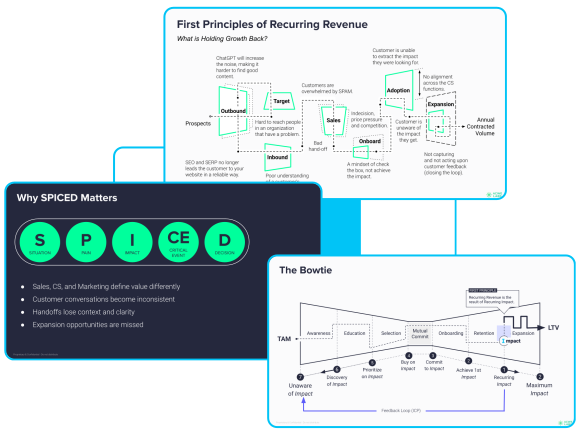
Alignment is hard to sustain in conversation and easy to sustain on a page. In the session, your revenue engine gets mapped to the Bowtie with the moments that matter marked at each stage, from ICP and messaging through hand-off, retention, and white space planning. SPICED sits across the lifecycle as the shared language for how buyers decide and how impact gets measured. Your leaders leave holding the same picture, which is what makes the next decision faster than the last one.
The Science of Revenue, Proven in Practice
Our frameworks drive repeatable results across sales, success, and revenue operations—validated through customer performance data and real-world outcomes.

Decrease in length of sales cycle

Increase in wins
Increase in ARR year over year

Increase in outbound pipeline share
Your Path to a Self-Sustaining Enablement System
Facilitated by the Experts Who’ve
Aligned Scaling Executive Teams




Built for the Leaders Accountable for Growth
For CEOs
You set the growth agenda and rely on your leaders to carry it. Alignment fails quietly when each executive is working from a different model of how growth works.
- Get your executive team operating from one model of the revenue system
- Replace recurring debate with shared definitions and agreed priorities
- Build a growth narrative your board and investors can follow
- Surface misalignment before it turns into a missed quarter
- Move the leadership team forward without a long engagement

For CROs
You carry the number across sales, marketing, and success. Cross-functional friction shows up in your forecast before it shows up anywhere else.
- Bring peers into one lifecycle view instead of separate scorecards
- Establish shared language for how buyers decide and how impact is measured
- Pull the CEO and CFO into the constraint conversation with evidence, not opinion
- Agree on the north star metrics your teams will actually steer by
- Reduce the handoff friction that costs velocity between functions

For Rev Ops / GTM Ops
You see where the system breaks and often lack the executive mandate to fix it. Alignment at the top is what turns your findings into decisions.
- Get leaders to agree on one set of definitions you can instrument
- Surface the structural constraints behind the symptoms you already track
- Turn your visibility into executive priority rather than another dashboard
- Establish a single lifecycle model as the source of truth
- Leave with a mandate instead of a request

For CMOs
You are asked to drive growth that gets judged well downstream of your work. A shared lifecycle view is what connects your investment to the outcome.
- Show how demand quality moves through sales, retention, and expansion
- Align marketing investment to lifecycle outcomes, not activity volume
- Build shared accountability with sales and success on the same model
- Establish where handoffs create friction before results are debated
- Argue from the system rather than defending spend

For CFOs
You are accountable for forecast credibility and capital efficiency. Both depend on whether the growth model your leaders describe matches the one that exists.
- Understand which growth assumptions carry the most risk
- Tie performance to system constraints instead of headcount or spend
- Bring shared definitions to planning and board communication
- Test whether the plan the team describes is the plan the system supports
- Improve confidence in growth decisions before capital is committed

Trusted by Leading Revenue Teams

Frequently Asked Questions
What is Executive Alignment?
Executive Alignment is a facilitated session that brings your C-suite and GTM leaders into agreement on one revenue system, one customer lifecycle view, and the north star metrics that matter. It includes preparation with your sponsor, a tailored 90-minute working session for three to ten leaders, and follow-up. It is part of Winning by Design’s Diagnose offerings.
Who should attend?
Executive Alignment is designed for C-level GTM leaders along with revenue operations and strategy leads. Sessions run with a minimum of three and a maximum of ten participants. The small group is deliberate, because alignment requires everyone in the room to speak.
How long is the session?
The live session runs 90 minutes. Preparation with your sponsor and key stakeholders happens beforehand, and follow-up happens after, so the full engagement is a single session with work on either side of it.
What is included in an Executive Alignment engagement?
Each engagement includes pre-session preparation with your sponsor and key stakeholders, a tailored 90-minute facilitated session, and the materials used in the room. Typical outputs are a shared growth framework, a unified lifecycle view, common terminology, and working hypotheses for where to focus.
What outcomes should we expect?
Leadership teams typically leave with one model of how growth works in their business, shared definitions across functions, and an agreed short list of priorities. Faster decisions and fewer reopened debates tend to follow, because the reasoning behind the priorities is now held in common.
How is this different from a leadership offsite or a strategy session?
Executive Alignment is structured around a model rather than an agenda. Your revenue engine gets mapped to the Bowtie and your terminology gets anchored in SPICED, so the session produces a shared system instead of a shared document. A facilitator draws out disagreement rather than smoothing it over.
Do we need a diagnostic or a data set first?
No. Executive Alignment requires no prior data work and often precedes deeper diagnostic engagements. What surfaces in the session is a set of working hypotheses, which a GTM Diagnostic or CxO Growth Guidance engagement can then validate with data.
How does this fit with your other Diagnose offerings?
Executive Alignment is frequently the starting point. It establishes shared language and priorities at the executive level, which makes a GTM Diagnostic or CxO Growth Guidance engagement faster and better targeted when leaders decide to go deeper. It stands on its own and is not a prerequisite for either.
Can the session be delivered onsite?
Yes. Executive Alignment is delivered remotely or onsite. Travel expenses are billed separately for onsite delivery.
How far in advance do we need to plan for the session?
Executive Alignment requires a minimum 3-week lead time. Preparation with your sponsor and stakeholders happens during that window and shapes the content of the session.
What happens after the session?
Your team keeps the session materials and the working hypotheses that came out of the room. Many teams use those priorities to sequence internal work. Others move into a diagnostic engagement to validate the hypotheses with lifecycle data before committing resources.
How much does an Executive Alignment engagement cost?
Engagements do vary in price depending on scope, company size, and level of customization. Please contact us for a quote tailored to your business and specific needs.
How do we know if this is the right next step for us?
If your leadership team is debating the same growth question each quarter, reconciling metrics that do not agree, or reopening decisions that were already made, Executive Alignment is usually the fastest way to establish a shared model. It is a short engagement, which makes it a low-risk starting point before larger commitments.
Talk with a GTM expert about your growth
We’ll help you understand what’s blocking predictable revenue and recommend the best path forward for your team.
-
Get clarity on the root causes slowing your growth
-
Understand which GTM improvements will deliver the biggest impact
-
Explore pricing, timelines, and the right engagement for your goals