Customer Success as a Profit Center
Customer Success is one of the most underutilized growth levers in B2B SaaS. Customer Success as a Profit Center shows why treating CS as a cost center caps growth—and how redesigning CS around retention, expansion, and recurring impact unlocks exponential revenue. When managed correctly, CS can outperform Sales as a long-term revenue engine.
Summary
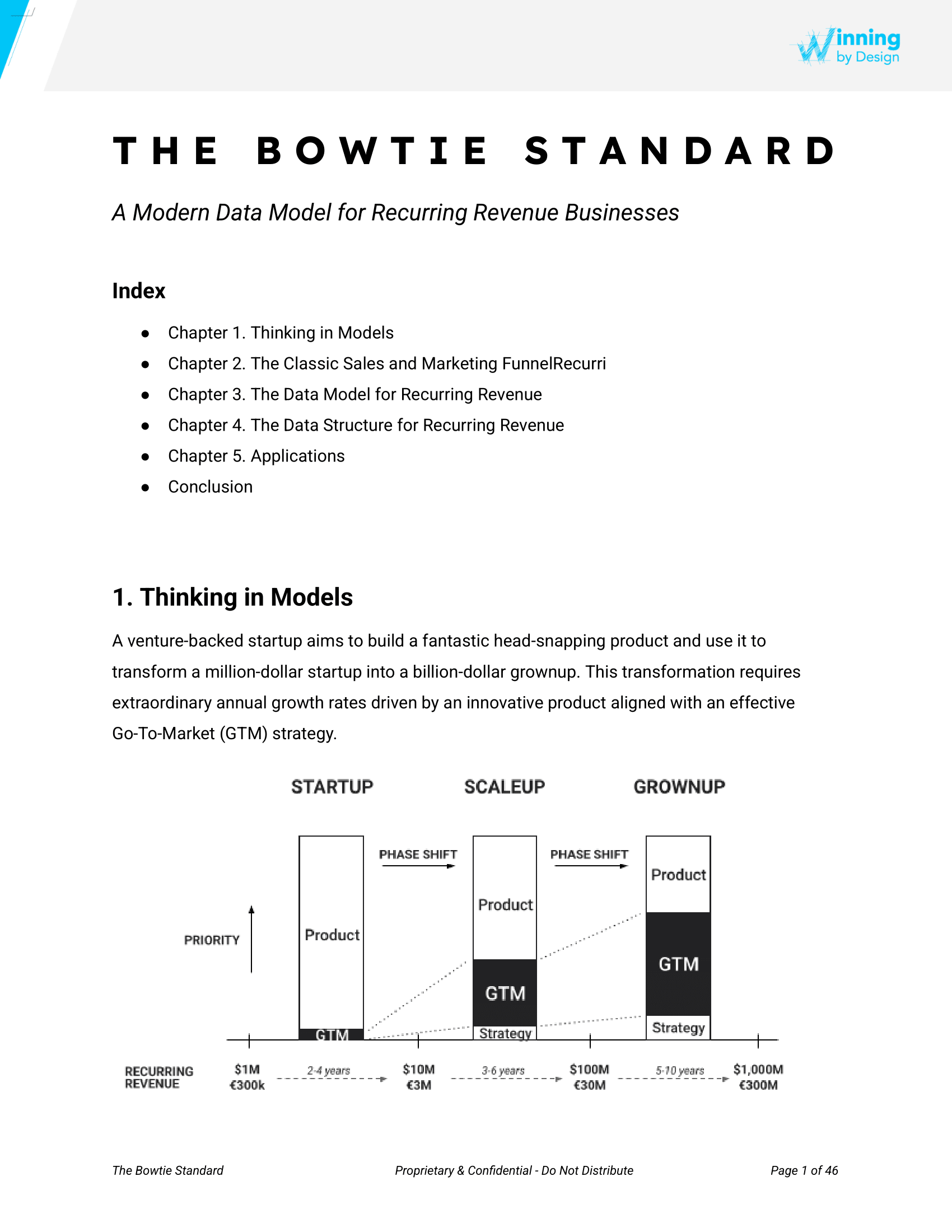
This research reframes Customer Success from a reactive churn-prevention function into a proactive, revenue-generating system. Using the Winning by Design Bowtie model and compound growth math, the paper demonstrates how onboarding (CR5), retention (CR6), and expansion (CR7) multiply over time to drive exponential customer lifetime value. It shows why small, continuous improvements in CS—such as increasing expansion frequency or reducing churn—produce outsized revenue gains, often equivalent to adding multiple new logos without acquisition cost. The paper also provides a practical operating model for CS 2.0, including how to design proactive customer journeys, calculate the correct CSM-to-account ratio based on time-to-impact (not revenue), and avoid the hidden revenue destruction caused by understaffed CS teams.
Best For
-
CEOs & Founders looking to unlock growth without increasing CAC
-
Chief Customer Officers & CS Leaders redesigning CS for revenue impact
-
CROs & Revenue Leaders aligning post-sale growth with GTM strategy
-
CFOs & Finance Leaders focused on CLV, profitability, and valuation
-
RevOps & Strategy teams standardizing post-sale metrics and operating models
Key Takeaways
-
Customer Success should be modeled as a profit center, not a cost center
-
CS drives exponential growth, not additive growth, through compounding retention and expansion
-
A 5% increase in retention can yield 25–95% revenue growth over time
-
Expansion opportunities should be pursued throughout the year, not only at renewal
-
Measuring CS by NPS or productivity misses its true revenue impact
-
The correct CSM-to-account ratio is determined by time-to-impact, not revenue per CSM
-
Cutting CS headcount often reduces revenue more than it saves costs
-
Small, consistent improvements across CR5–CR7 compound into massive CLV gains
oid the hidden revenue destruction caused by understaffed CS teams.
Overview
FORMAT
PDF (18 Pages)
READ TIME
45-50 Minutes
AUTHORS
Julie Weill Persofsky, Jacco van der Kooij
PUBLISHED
March 11, 2021

Talk with a GTM expert about your GTM growth
We’ll help you understand what’s blocking predictable revenue and recommend the best path forward for your team.
-
Get clarity on the root causes slowing your growth
-
Understand which GTM improvements will deliver the biggest impact
-
Explore pricing, timelines, and the right engagement for your goals